Category Archives: dataviz

IDV4GH Coming Soon

Papers my interactive data visualization students will be reading soon: http://fellinlovewithdata.com/guides/7-classic-foundational-vis-papers

(I just completed teaching an intensive course on Interactive Data Visualization for Global Health (IDV4GH). In hind-sight, much of my plan was overly optimistic about how much can be packed into 30 hours.)

Comments Off on IDV4GH Coming Soon

Filed under dataviz

What is “hello, world” for statistical graphics?

Tell me on cross-validated.

1 Comment

Filed under dataviz

Same Chernoff

I’ve been reading up on the Chernoff face for data visualization, which, as I’ve mentioned, is so cute. This helped me demonstrate that I haven’t forgotten everything from my grad school days, like a bound with name similar to the face. Back in my olden days, I thought Chernoff bounds were the cutest, and Chernoff faces were quite far from what I spent my time on.

So what a nice continuity that I learned it was the same Chernoff who lent his name to both the bound and the face. He seems to have a good sense of humor about both, and says that a different Herman deserves credit for the bound:

My result, involving the infimum ofa moment generating function, was less elegant and less general than the Cramer result, but did not require a special condition that Cramer required. Also, my proof could be described as crudely beating the problem to death. Herman claimed that he could get a lower bound much easier. I challenged him, and he produced a short Chebyshev Inequality type proof, which was so trivial that I did not trouble to cite his contribution.

What a mistake! It seems that Shannon had incorrectly applied the Central Limit theorem to the far tails of the distribution in one of his papers on Information theory. When his error was pointed out, he discovered the lower bound of Rubin in my paper and rescued his results. As a result I have gained great fame in electrical engineering circles for the Chernoff bound which was really due to Herman. One consequence of the simplicity of the proof was that no one ever bothered to read the original paper of which I was very proud. For years they referred to Rubin’s bound as the Chernov bound, not even spelling my name correctly. … Fortunately for me, my lasting fame, if any, will depend, not on Rubin’s bound, but on Chernoff faces.

Comments Off on Same Chernoff

Filed under dataviz

Baby Faces II

I knew I read something about baby faces recently, and now I found it. It was in a Malcolm Gladwell book. This guy should be my inspiration.

Comments Off on Baby Faces II

Filed under dataviz

DataViz in Python: Chernoff Faces with Matplotlib

As promised previously, here is my effort towards drawing Chernoff faces as cute as they were in the original paper.

Isn’t that just the cutest? Code here.

My replication was greatly aided by a graphic that I call “the missing figure”, which I found on a website that has since disappeared. It helped me understand what Chernoff’s paper was talking about when it says the corner of the face:

Here are a few other ways to look at it:

Varying one parameter at a time:

Lots and lots of random faces:

Making that figure reminds me of a wonderfully vintage quote from Chernoff’s 1972 paper:

“At this time the cost of drawing these faces is about 20 to 25 cents
per face on the IBM 360-67 at Stanford University using the Calcomp
Plotter. Most of this cost is in the computing, and I believe that it
should be possible to reduce it considerably. ”

I’d pay $250 for a beautiful plot of that last figure. But it is nice that the price has come down.

5 Comments

Filed under dataviz

Baby faces and Chernoff faces

I’ve been spending a lot of time looking at faces lately. Baby faces, to be specific. Baby faces are just wonderful, especially my baby, if I do say so myself. In fact, that adorable baby, said face, and said staring are making me forget my “blogging” voice. I think I can recover it with a little effort.

There is a face-related visualization technique that I’ve been planning to write about, and this seems like just the moment: recall Chernoff Faces. This 1970s-era method for multidimensional data visualization is so cute that it has been a recurring example in visualization education for 40 years, but it is so hard to use that it is almost never used in practice. Have you seen it before?

There are two major problems with this method: it is almost always a mistake to use it for public communication (Eugene Turner’s map of LA above is a rare exception), and it is almost always a mistake to use it in a dashboard. It has lived on from its original paper because it is so cute, but it made it to publication in its original paper because it was used appropriately: as a human computation aid in a clustering task.


It looks to me like there are three different shaped faces in the above figure. Agree?

This hasn’t always gone so well, though, as an example from a subsequent application by different authors shows below. In the following, do you see anything worth grouping together? I guess they show only a single exemplar from each cluster here, so they’re all supposed to look different.
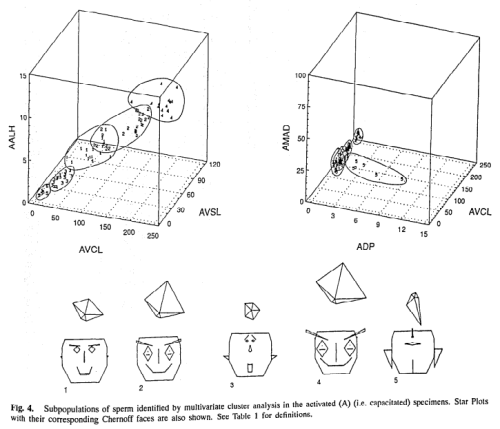
But I’m still excited about for the same reason as everyone else: faces are so cute! I have come up with a related human computation task where it may also be useful: outlier detection.

I’m not the first to want to do this, and it has even been attempt in health service research before:

(from here)


(from here)

A quick search turns up lots of code for generating faces from multidimensional data, but nothing as cute as Chernoff’s original work. I’ll remedy that in a near future post. Unless you know of something already out there that I missed.

2 Comments

Filed under dataviz