
This week’s journal club selection is Performance of Health Workers in the Management of Seriously Sick Children at a Kenyan Tertiary Hospital: Before and after a Training Intervention by Irimu et al. That sounds hard to quantify, so I wonder how they did it.
Tag Archives: journal club
Journal club: Performance of Health Workers in the Management of Seriously Sick Children at a Kenyan Tertiary Hospital
Comments Off on Journal club: Performance of Health Workers in the Management of Seriously Sick Children at a Kenyan Tertiary Hospital
Filed under global health
Extra Journal Club: Cd exposure and neurodevelopment
I’m sure reading a lot lately. That is good. This week, I’m filling in for the PBF journal club, too, and today we’ll be discussing Ciesielski et al’s paper Cadmium Exposure and Neurodevelopmental Outcomes in U.S. Children, which uses 6 years of NHANES data to weigh the evidence that low levels of cadmium cause learning disabilities in children.
All the data is available on the CDC’s website, so I thought I’d take a look at it. Here is an interesting little plot that popped out: prevalence of parent-reported learning disabilities in 6-15 year olds as a function of income-to-poverty-line ratio.
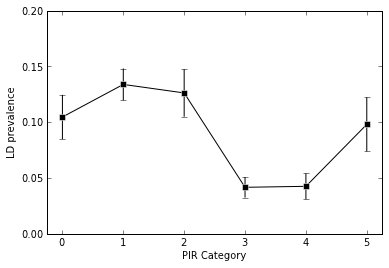
Would you have expected that?
Filed under global health, Mysteries
Journal Club: GBD 2010
I wonder how we’ll tear holes in the arguments of this week’s journal club papers, since they are locally produced:
- Murray et al, GBD 2010: design, definitions, and metrics, The Lancet, Volume 380, Issue 9859, Pages 2063 – 2066, 15 December 2012.
- Murray et al, Disability-adjusted life years (DALYs) for 291 diseases and injuries in 21 regions, 1990—2010: a systematic analysis for the Global Burden of Disease Study 2010, The Lancet, Volume 380, Issue 9859, Pages 2197 – 2223, 15 December 2012.
Also have a look at the accompanying visualizations.
Comments Off on Journal Club: GBD 2010
Filed under global health
Journal Club: Comparison of a community outreach service with opportunity screening for cervical cancer using Pap smears
This week journal club takes on Comparison of a community outreach service with opportunity screening for cervical cancer using Pap smears by Chang et al.
Given existing nationwide organized Pap smear screening for cervical cancer in Taiwan, this study demonstrates that outreach Pap smear screening services may be a means of enhancing accessibility and thereby increasing attendance. Approximately 90% women attending outreach service had not previously accessed the pre-existing Pap smear examination provided in hospital. The enhancement of accessibility was particularly significant for certain subgroups of women (the elderly, the widowed and less well educated).
Comments Off on Journal Club: Comparison of a community outreach service with opportunity screening for cervical cancer using Pap smears
Filed under global health
Journal Club: Death certificates for diabetes
This week we will investigate how frequently death certificates capture diabetes prevalence:
McEwen et al, Temporal Trends in Recording of Diabetes on Death Certificates
Cheng et al, Sensitivity and Specificity of Death Certificates for Diabetes: As Good as it Gets?
Results (spoiler alert): McEwen et al – Diabetes was recorded on 41% of death certificates and as the underlying cause of death for 13% of decedents with diabetes. Cheng et al – Among 1641 men and 1568 women, 378 decedents had a history of diabetes; 168 of whom had diabetes listed anywhere on their death certificates.
Filed under global health
Journal Club: Information for decision making from imperfect national data
A nice connection from last week’s journal club paper to this week’s: the errors in health information system data. Last week was about correcting the bias from missing individuals. This week is about correcting the bias from missing facilities.
From the key figure, it looks like missing individuals bias things more:

Filed under global health
Journal Club: Sampling-Based Approach to Determining Outcomes of Patients Lost to Follow-Up in Antiretroviral Therapy Scale-Up Programs in Africa
This week’s paper for journal club is short and has a nice figure:
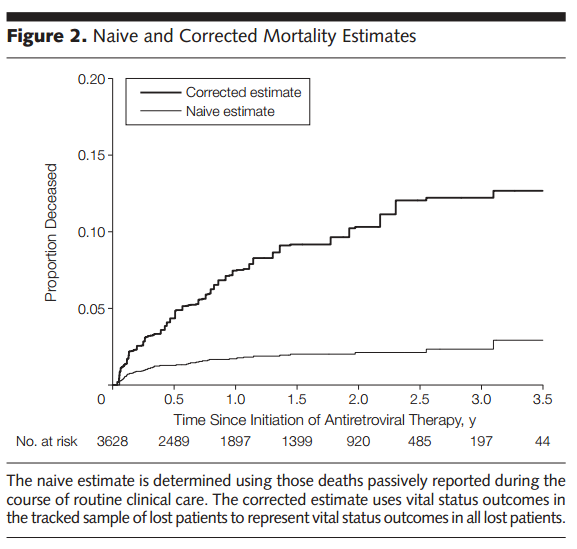
It looks like this corrected estimate is quite different than the uncorrected version!
I think the mathematics involved have an extended treatment in this work referenced by Geng et al: Addressing an idiosyncrasy in estimating survival curves using double-sampling in the presence of self-selected right censoring
Filed under global health
 Healthy Algorithms