
Cool project for teaching programming through web games: Play My Code

How to embed the game in the blog?
Cool project for teaching programming through web games: Play My Code
How to embed the game in the blog?
Comments Off on Code as Play
Filed under education
Claire Mathieu has been blogging about intro math and CS videos from Khan Academy and from others:
I’ve heard about this Khan Academy, and it seems like more and more course material is appearing as tiny web videos.
Also I recently found out that there is a free, online version of the Stanford Intro AI Class taught by Peter Norvig and Sebastian Thrun, for which 56,000 students signed up. I think I accidentally did their homework.
Filed under education
Ben Birnbaum stood for his general exam last week, on a topic that I’m very interested in:
ABSTRACT–
Surveys are one of the principal means of gathering critical data from low-income regions. However, interviewer fabrication, or curbstoning, can threaten data quality. The existing literature lacks a set of general-purpose techniques to detect curbstoning; it does not capitalize on the potential of mobile data collection tools to help detect the phenomenon; and it provides few rigorous validations of the techniques that are developed. In this talk, I propose an anomaly detection framework to develop several general-purpose algorithms that identify curbstoning.
These algorithms can take advantage of the information in user traces from mobile data collection, a potential that I will evaluate rigorously. I also propose two studies to obtain high-quality labeled data sets with which I will validate my algorithms, thus partially filling the need for more rigorous evaluations.
Good job, Ben! Also in attendance was Aram Harrow, who was reminded of this great story of the lying professor. I wonder, could I could pull that off?
Comments Off on False information
Filed under education
I just returned from the SciPy 2011 conference in Austin. Definitely a different experience than a theory conference, and definitely different than the mega-conferences I’ve found myself at lately. I think I like it. My goal was to evangelize for PyMC a little bit, and I think that went successfully. I even got to meet PyMC founder Chris Fonnesbeck in person (about 30 seconds before we presented a 4 hour tutorial together).
For the tutorial, I put together a set of PyMC-by-Example slides and code to dig into that silly relationship between Human Development Index and Total Fertility Rate that foiled my best attempts at Bayesian model selection so long ago.
I’m not sure the slides stand on their own, but together with the code samples they should reproduce my portion of the talk pretty well. I even started writing it up for people who want to read it in paper form, but then I ran out of momentum. Patches welcome.
Comments Off on PyMC at SciPy 2011
Filed under education, global health, MCMC, statistics
Just like last summer, many of the Post-Bachelors Fellows of IHME are away now to learn where global health metrics come from. Spencer James has a great photoblog from his work in Zambia. Are there other PBFs that I can follow from afar?

Comments Off on PBFs Summer
Filed under education
David Eppstein has written up a guide for scientists who want to get started contributing to Wikipedia.
Here is why you might want to write for Wikipedia, from Eppstein’s writeup:
Why?
You already have other avenues for publishing your writing professionally, and plenty of demands on your time. Why should you take the extra time to write for Wikipedia as well?
- Public service. Part of being a scientist is communicating to the public, and Wikipedia is a great way of writing about research in a way that can be found and read by the public.
- Give and take. As a research scientist you are benefiting from a vast collection of survey articles written by the Wikipedia community. Why not reciprocate and help improve the existing articles by sharing your knowledge?
- Righting wrongs. You’ve probably already found some important topics that you know about from your research that are missing from Wikipedia, or worse, described incorrectly. Who better than someone who knows about these topics professionally to repair the damage?
- Practice. To write well on Wikipedia, you have to pay more attention to matters of readability than you might when writing for your peers. Practicing your writing ability in this way is likely to cause your professional writing to improve.
- Broaden your knowledge. When you write about a topic, you learn about it yourself; you may well find the topics you write about useful later in your own research. Also, when you carefully survey a topic, you are likely to find out about what is not known as well as what is known, and this could help you find future research projects.
- It looks good on your vita. Actually, I don’t think any tenure committee is going to care about your Wikipedia contributions. And in most cases the fact that you’ve contributed to an article is invisible to most readers, so it’s also not going to do much for making you more famous. But recently the NSF has started to take “broader impacts” more seriously on grant applications, and if you can make a convincing case that your Wikipedia editing activity is significant enough to count as a broader impact then that will probably improve your chances of getting funding. And getting more funding really does look good on your vita.
- Your advisor asked you to. This may or may not be a good reason, depending on what your advisor asked you to edit. Articles about a general subject area that you’re starting to learn about in your own research, as a way of making a public contribution while helping you learn: good. Articles about your advisor or his/her own research: not so good.
I agree.
Comments Off on Wikipedia Editing for Scientists
Filed under education
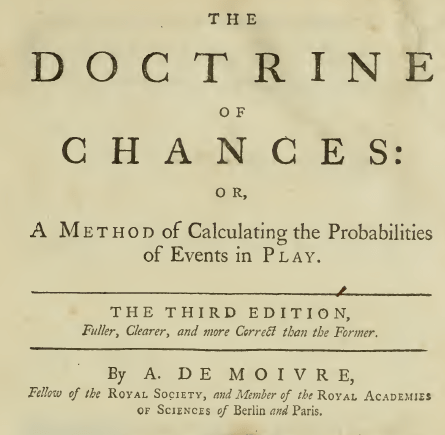
I had a need to look in the first-ever probability textbook this weekend. It isn’t really ancient, but it is definitely old. And it’s all on the Internet Archive as a pdf. Good times.
Abraham de Moivre, The doctrine of chances: or, A method of calculating the probabilities of events in play (1756)
Filed under education
I’m supposed to be writing a lot right now. Papers, grants, documentation, there’s lots to write (blogs don’t count). But I’ve been a little bit blocked, so I’ve been reading instead. Since I spend so much time reading things where the idea is paramount and the prose is barely functional, I thought I’d mix it up and read some things that are well written just because they are well written. Maybe I’ll get inspiration from authors who put words together well.
On that note, I just finished up Slumberland, the latest novel by Paul Beatty. I like the idea that great writing is happening currently, and not just something in the “classics” section of the library.
Beatty writes epics about Black superheros, so there was no reason for me to expect math to make an appearance in his latest story. Its about an American deejay who moves to pre-unification Berlin with the perfect beat. That makes the math content here the exact opposite of what I complained about after I saw Salt last summer, where screenwriters made Angelina Jolie math-phobic for no reason.
It was quite a pleasant surprise when early on in the book, following some laugh-out-loud funny dialogue that I won’t even hint at here, the surprising results of a math test come out:
The scores were posted outside the classroom in descending order. It was the first computer printout I’d ever seen. There was something affirming about seeing my name and score—FERGUSON W. SOWELL: 100/100—at the top of the list in what was then a futuristic telex font. I felt official. I was real.
Thank you, Paul Beatty, for making your superhero a math whiz on the side.
Comments Off on Reading Time
Filed under education
Jennifer Rexford’s advice for new grad students is also good for old grad students and new post-docs. See it on the Freedom to Tinker Blog.
Comments Off on Advice for new grad students
Filed under education
School is starting up, and I’m absolved of teaching duties for my first year as a prof. Very nice, but it is strange to see the trees turning towards fall without classes keeping me busy. I’m going to try to look over the shoulder of the new IHME students. They’re almost all taking an intro biostats course, which is stuff that I should know. I never took a class in it, so I suspect there are gaps in my knowledge… I don’t even know what I don’t know.
Meanwhile, in Colorado, Aaron Clauset is giving a class that I wish I had taken in grad school, Inference, Models and Simulation for Complex Systems. The reading list is full of things I like, so maybe I’ll pretend I’m still a student and read the ones I haven’t yet.
Comments Off on Fall Classes
Filed under education
 Healthy Algorithms