Category Archives: global health

Journal Club: Sampling-Based Approach to Determining Outcomes of Patients Lost to Follow-Up in Antiretroviral Therapy Scale-Up Programs in Africa

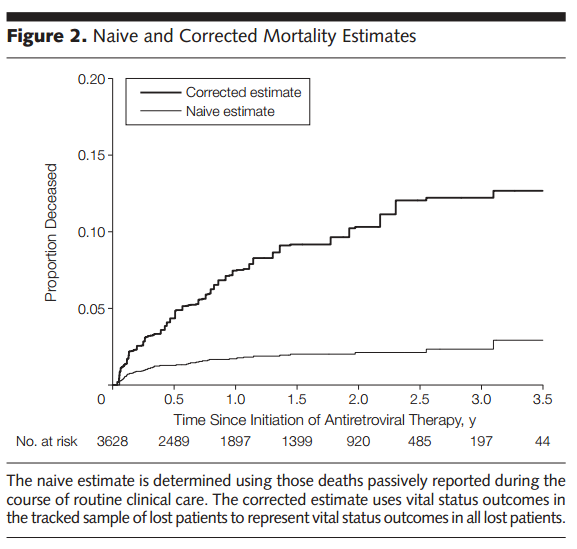
This week’s paper for journal club is short and has a nice figure:

Geng et al, Sampling-Based Approach to Determining Outcomes of Patients Lost to Follow-Up in Antiretroviral Therapy Scale-Up Programs in Africa
naive_and_corrected

It looks like this corrected estimate is quite different than the uncorrected version!

I think the mathematics involved have an extended treatment in this work referenced by Geng et al: Addressing an idiosyncrasy in estimating survival curves using double-sampling in the presence of self-selected right censoring

2 Comments

Filed under global health

Journal Club is Back

Or actually, I am back. Back to facilitating the post-graduate fellowship (PGF) journal club. Here is what we are reading this week, Impact assessment of malaria vector control using routine surveillance data in Zambia: implications for monitoring and evaluation, which is a highly accessed article according to the Malaria Journal website. Is it also highly accessible? We shall see. Any wisdom on this that I can pass on to the fellows is welcome.

Figure 1. Estimated operational ITN distributions by district in Zambia from 2003–2010, representing percentage of district households receiving 3 ITNs per household (HH) in overlapping 3-year intervals (MoH, 2010).

Figure 1. Estimated operational ITN distributions by district in Zambia from 2003–2010, representing percentage of district households receiving 3 ITNs per household (HH) in overlapping 3-year intervals (MoH, 2010).

1 Comment

Filed under global health

GBD 2010

The massive project I’ve been working on since moving from math to global health has been published!

The Global Burden of Disease Study 2010 (GBD 2010) is the largest ever systematic effort to describe the global distribution and causes of a wide array of major diseases, injuries, and health risk factors. The results show that infectious diseases, maternal and child illness, and malnutrition now cause fewer deaths and less illness than they did twenty years ago. As a result, fewer children are dying every year, but more young and middle-aged adults are dying and suffering from disease and injury, as non-communicable diseases, such as cancer and heart disease, become the dominant causes of death and disability worldwide. Since 1970, men and women worldwide have gained slightly more than ten years of life expectancy overall, but they spend more years living with injury and illness.

GBD 2010 consists of seven Articles, each containing a wealth of data on different aspects of the study (including data for different countries and world regions, men and women, and different age groups), while accompanying Comments include reactions to the study’s publication from WHO Director-General Margaret Chan and World Bank President Jim Yong Kim. The study is described by Lancet Editor-in-Chief Dr Richard Horton as “a critical contribution to our understanding of present and future health priorities for countries and the global community.”

Now I have to get my book about the methods out the door as well…

2 Comments

Filed under global health

Automated Quality Assurance for Mobile Data Collection

I’m excited to call your attention to a paper that my co-author Ben Birnbaum is presenting next week at the ACM DEV conference:

This research is about… well, the title says it pretty clearly. I’m interested in using our approach to detect surprises in data quality in all kinds of settings. Ben did the heavy lifting for this paper, so he deserves a lot of the congratulations that it has received the best paper award from the DEV 2012 program committee.

Congratulations, Ben!

Comments Off on Automated Quality Assurance for Mobile Data Collection

Filed under global health

Cool Tool

Here is a web tool that recently crossed my desk, an interactive map on the human cost of mountaintop removal. It is a mashup of a bunch of different data sources, all on a Google map, that all say it is not healthy to live near a mountaintop removal coal mine.

Comments Off on Cool Tool

Filed under global health

I-TECH’s Everydayleadership.org

There are many sides to global health, and the quantitative, metrics-y part that I write about here is but one. My colleagues from the UW Global Health Department at I-TECH work on another, which intrigues me, and might be called “leadership development”. They have just released a large collection of short videos about leadership, on a slick new website.

Here is a video that I liked, 2 minutes of the country director in South Africa for the US Centers for Disease Control talking about the complexity of transparency:


More videos by Thurma Goldman on Everydayleadership.org

There are a lot of videos there, so if you see one you recommend, post a link in the comment section for me.

Comments Off on I-TECH’s Everydayleadership.org

Filed under global health

Flock of VA papers

I’m afraid that Healthy Algorithms will be pretty quiet in the next month, I’ve got some major other writing commitments to attend to, and I need to ration my keystrokes if I’m going to make the deadline.

But here is something I’m happy to leave at the top of the page while I’m busy: the special issue of Population Health Metrics devoted to the Verbal Autopsy is provisionally available.

This includes the paper on using random forests for computer coding verbal autopsies that I’ve mentioned before, a paper describing the massive efforts that went into collecting a verbal autopsy validation dataset, and a paper on our take on the metrics of prediction quality that we recommend for any approach to verbal autopsy.

Bonus, a commentary that quotes Foucault to put random forests in context.

2 Comments

Filed under global health

PyMC at SciPy 2011

I just returned from the SciPy 2011 conference in Austin. Definitely a different experience than a theory conference, and definitely different than the mega-conferences I’ve found myself at lately. I think I like it. My goal was to evangelize for PyMC a little bit, and I think that went successfully. I even got to meet PyMC founder Chris Fonnesbeck in person (about 30 seconds before we presented a 4 hour tutorial together).

For the tutorial, I put together a set of PyMC-by-Example slides and code to dig into that silly relationship between Human Development Index and Total Fertility Rate that foiled my best attempts at Bayesian model selection so long ago.

I’m not sure the slides stand on their own, but together with the code samples they should reproduce my portion of the talk pretty well. I even started writing it up for people who want to read it in paper form, but then I ran out of momentum. Patches welcome.

Comments Off on PyMC at SciPy 2011

Filed under education, global health, MCMC, statistics

Speaking of IE

Speaking of IE, which usually stands for Industrial Engineering, but at Cornell now stands for Information Engineering (or OR/MS, which stands for Operations Research/Management Sciences), there is a subdiscipline of global health that is going through a familiar search for the perfect name. It is actually somewhat related to OR/MS, definitely it would fit in at an INFORMS meeting. For a while was going to be called “Operational Research”, which I find confusing, since this is the old European name for Operations Research. But now it seems like they too want to have “science” in the name. The new contenders are “Implementation Science” and “Program Science”.

Any thoughts from veterans of the “OR/MS” naming process that I should share with my colleagues in a similar situation?

Comments Off on Speaking of IE

Filed under global health

IE Challenges in Global Health

I adapted my “Theoretical Computer Science Challenges in Global Health” for the UW Industrial Engineering department a couple of weeks ago. Instead of 10 minutes on noisy sorting for disability weight estimation, now it has 10 minutes stochastic optimization for disease control priorities. I consider it still a work in progress, but I do have a nice recording of the lecture if anyone wants some relaxing viewing:

Comments Off on IE Challenges in Global Health

Filed under global health