Category Archives: statistics

Rewind Data Augmentation to EM

The original paper on Data Augmentation (DA) got me thinking it was time to have a careful look at the original paper on EM. These are both highly cited papers, and Google scholar says the DA paper has been cited 2538 times (a lot!) and the EM paper has been cited 31328 times (is that possible?).

EM (which stands of Expectation-Maximization) is something I have heard about a lot, and, as an algorithm, it is even something I understood when I read a blog post relating it to a clustering algorithm that I now cannot find (maybe on the Geomblog). The arguments from the EM to DA paper, which I read recently, makes me think that there is something more than the algorithm going on here. In this later paper, Tanner and Wong identify the importance of Section 4 of the EM paper, which provides a collection of example applications of their EM algorithm. Is there something about this way of thinking that is even more important than the algorithm itself?

Comments Off on Rewind Data Augmentation to EM

Filed under statistics

What is data augmentation?

I’ve started summarizing papers for MathSciNet again, a strangely arcane practice coordinated by the American Mathematical Society. MathSciNet is a vast database of short reviews of math publications, and I loved it when I was writing the background sections of my graduate thesis. It was so useful then that I’m compelled to write summaries for it now, if I can make the time. Like reviewing, it makes me read a range of recent papers, but unlike reviewing, I don’t need to make a fuss about things that seem wrong. Fun.

I used to get to read some of the latest and greatest results in random graphs this way, but since I started up again, I’ve adjusted my preferences to receive some latest and greatest results in statistical computation. Hence my new appreciation for “data augmentation”, a term that doesn’t seem like good branding to me, but might be the key to MCMC coming into vogue for Bayesian computation.

Here is a little research list for my future self to investigate further:

1 Comment

Filed under statistics

Tukey quote I half-remembered

I was trying to remember some quote by the exploratory data analysis master John Tukey yesterday, and I think this is it:

No catalog of techniques can convey a willingness to look for what can be seen, whether or not anticipated. Yet this is at the heart of exploratory data analysis. The graph paper—and transparencies—are there, not as a technique, but rather as a recognition that the picture-examining eye is the best finder we have of the wholly unanticipated.

It is from John W. Tukey, We Need Both Exploratory and Confirmatory, The American Statistician, Vol. 34, No. 1 (Feb., 1980), pp. 23-25.

I remembered a version about the visual cortex as a the most advance signal processing device, so maybe there is another version of this out there.

Comments Off on Tukey quote I half-remembered

Filed under statistics

Parameterizing Negative Binomial distributions

The negative binomial distribution is cool. Sometimes I think that.

Sometimes I think it is more trouble than it’s worth, a complicated mess.

Today, both.

Wikipedia and PyMC parameterize it differently, and it is a source of continuing confusion for me, so I’m just going to write it out here and have my own reference. (Which will match with PyMC, I hope!)

The important thing about the negative binomial, as far as I’m concerned, is that it is like a Poisson distribution, but “over-dispersed”. That is to say that the standard deviation is not always the square root of the mean. So I’d like to parameterize it with a parameter \mu for the mean and \delta for the dispersion. This is almost what PyMC does, except it calls the dispersion parameter \alpha instead of \delta.

The slightly less important, but still informative, thing about the negative binomial, as far as I’m concerned, is that the way it is like a Poisson distribution is very direct. A negative binomial is a Poisson that has a Gamma-distributed random variable for its rate. In other words (symbols?), Y \sim \text{NegativeBinomial}(\mu, \delta) is just shorthand for

Y \sim \text{Poisson}(\lambda),
\lambda \sim \text{Gamma}(\mu, \delta).

Unfortunately, nobody parameterizes the Gamma distribution this way. And so things get really confusing.

The way to get unconfused is to write out the distributions, although after they’re written, you might doubt me:

The negative binomial distribution is
f(k \mid \mu, \delta) = \frac{\Gamma(k+\delta)}{k! \Gamma(\delta)} (\delta/(\mu+\delta))^\delta (\mu/(\mu+\delta))^k
and the Poisson distribution is
f(k \mid \lambda) = \frac{e^{-\lambda}\lambda^k}{k!}
and the Gamma distribution is
f(x \mid \alpha, \beta) = \frac{\beta^{\alpha}x^{\alpha-1}e^{-\beta x}}{\Gamma(\alpha)}

Hmm, does that help yet? If \alpha = \delta and \beta = \delta/\mu, it all works out:
\frac{\Gamma(k+\delta)}{\Gamma(\delta)k!} \left(\frac{\delta}{\pi+\delta}\right)^\delta \left(\frac{\pi}{\pi+\delta}\right)^k  =  \int_0^\infty \frac{e^{-\lambda}\lambda^k}{k!} \lambda^{\delta-1} e^{-\lambda \delta/\mu} \frac{(\delta/\mu)^{\delta}}{\Gamma(\delta)}d \lambda.

But instead of integrating it analytically (or in addition to), I am extra re-assured by seeing the results of a little PyMC model for this:

I put a notebook for making this plot in my pymc-examples repository. Love those notebooks. [pdf] [ipynb]

1 Comment

Filed under statistics

PyMC at SciPy 2011

I just returned from the SciPy 2011 conference in Austin. Definitely a different experience than a theory conference, and definitely different than the mega-conferences I’ve found myself at lately. I think I like it. My goal was to evangelize for PyMC a little bit, and I think that went successfully. I even got to meet PyMC founder Chris Fonnesbeck in person (about 30 seconds before we presented a 4 hour tutorial together).

For the tutorial, I put together a set of PyMC-by-Example slides and code to dig into that silly relationship between Human Development Index and Total Fertility Rate that foiled my best attempts at Bayesian model selection so long ago.

I’m not sure the slides stand on their own, but together with the code samples they should reproduce my portion of the talk pretty well. I even started writing it up for people who want to read it in paper form, but then I ran out of momentum. Patches welcome.

Comments Off on PyMC at SciPy 2011

Filed under education, global health, MCMC, statistics

Computation time and model development

20 seconds, 20 minutes, or 20 hours.  These are all amounts of time that a computational method I’ve been working at some time has taken to complete processing.  They each lead to a very different experience for the model developer, and probably in the end for the model, too. Twenty seconds is definitely what I prefer.

Comments Off on Computation time and model development

Filed under statistics, TCS

New Stats Books

Here is a new book on Bayesian stats that Kyle forwarded on to me: Principles of Uncertainty.  Chapter 11 looks unique, on “multiparty problems”, and a pdf of the whole thing is available from the book website for download.

Comments Off on New Stats Books

Filed under statistics

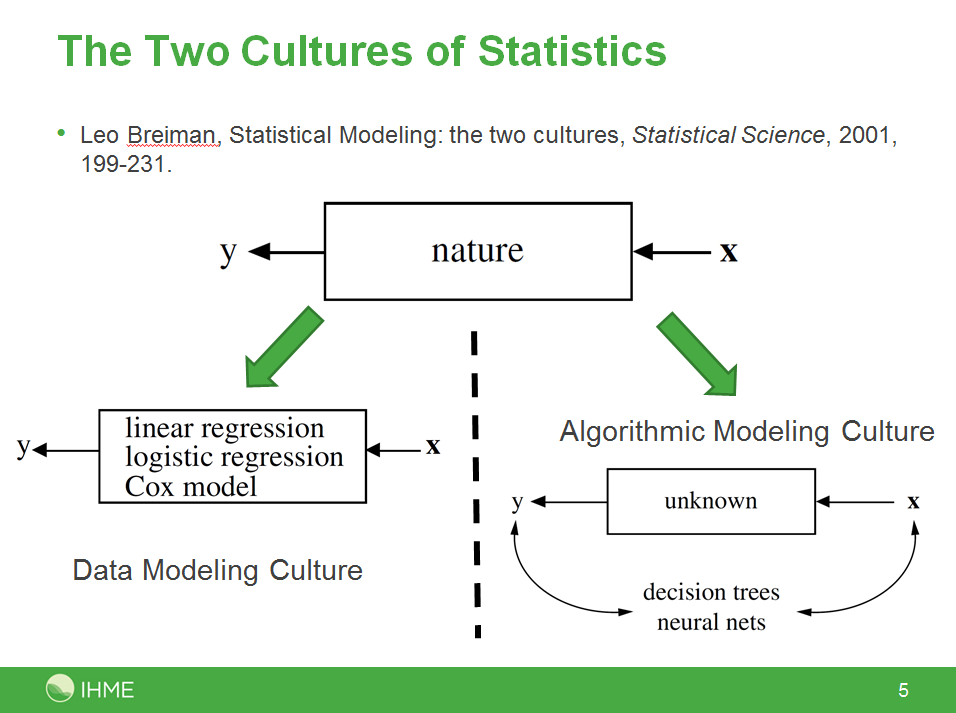
A Slide I Like

I’m updating a talk about machine learning for verbal autopsy analysis, and I thought I’d share a slide I like. I wonder what statisticians think about this view of the world:


Comments Off on A Slide I Like

Filed under statistics

MCMC in Python: A simple random effects model and its extensions

A nice example of using PyMC for multilevel (aka “Random Effects”) modeling came through on the PyMC mailing list a couple of weeks ago, and I’ve put it into a git repo so that I can play around with it a little, and collect up the feedback that the list generates.

Here is the situation:

Hi All,

New to this group and to PyMC (and mostly new to Python). In any case, I’m writing to ask for help in specifying a multilevel model (mixed model) for what I call partially clustered designs. An example of a partially clustered design is a 2-condition randomized psychotherapy study where subjects are randomly assigned to conditions. In condition 1, subjects are treated in small groups of say 8 people a piece. In the condition 2, usually a control, subjects are only assessed on the outcome (they don’t receive an intervention). Thus you have clustering in condition 1 but not condition 2.

The model for a 2-condition study looks like (just a single time point to keep things simpler):
y_{ij} = b_0 + b_1 Tx + u_j Tx + e_{ij},
where y_ij is the outcome for the ith person in cluster j (in most multilevel modeling software and in PROC MCMC in SAS, subjects in the unclustered condition are all in clusters of just 1 person), b_0 is the overall intercept, b_1 is the treatment effect, Tx is a dummy coded variable coded as 1 for the clustered condition and 0 for the unclustered condition, u_j is the random effect for cluster j, and e_ij is the residual error. The variance among clusters is \sigma^2_u and the residual term is \sigma^2_e (ideally you would estimate a unique residual by condition).

Because u_j interacts with Tx, the random effect is only contributes to the clustered condition.

In my PyMC model, I expressed the model in matrix form – I find it easier to deal with especially for dealing with the cluster effects. Namely:

Y = XB + ZU + R,
where X is an n x 2 design matrix for the overall intercept and intervention effect, B is a 1 x 2 matrix of regression coefficients, Z is an n x c design matrix for the cluster effects (where c is equal to the number of clusters in the clustered condition), and U is a c x 1 matrix of cluster effects. The way I’ve written the model below, I have R as an n x n diagonal matrix with \sigma^2_e on the diagonal and 0’s on the off-diagonal.

All priors below are based on a model fit in PROC MCMC in SAS. I’m trying to replicate the analyses in PyMC so I don’t want to change the priors.

The data consist of 200 total subjects. 100 in the clustered condition and 100 in the unclustered. In the clustered condition there are 10 clusters of 10 people each. There is a single outcome variable.

I have 3 specific questions about the model:

  1. Given the description of the model, have I successfully specified the model? The results are quite similar to PROC MCMC, though the cluster variance (\sigma^2_u) differs more than I would expect due to Monte Carlo error. The differences make me wonder if I haven’t got it quite right in PyMC.
  2. Is there a better (or more efficient) way to set up the model? The model runs quickly but I am trying to learn Python and to get better at optimizing how to set up models (especially multilevel models).
  3. How can change my specification so that I can estimate unique residual variances for clustered and unclustered conditions? Right now I’ve estimated just a single residual variance. But I typically want separate estimates for the residual variances per intervention condition.

Here are my first responses:

1. This code worked for me without any modification. 🙂 Although when
I tried to run it twice in the same ipython session, it gave me
strange complaints. (for pymc version 2.1alpha, wall time 78s).
For the newest version in the git repo (pymc version 2.2grad,
commit ca77b7aa28c75f6d0e8172dd1f1c3f2cf7358135, wall time 75s) it
didn’t complain.

2. I find the data wrangling section of the model quite opaque. If
there is a difference between the PROC MCMC and PyMC results, this
is the first place I would look. I’ve been searching for the most
transparent ways to deal with data in Python, so I can share some
of my findings as applied to this block of code.

3. The model could probably be faster. This is the time for me to
recall the two cardinal rules of program optimization: 1) Don’t
Optimize, and 2) (for experts only) Don’t Optimize Yet.

That said, the biggest change to the time PyMC takes to run is in
the step methods. But adjusting this is a delicate operation.
More on this to follow.

4. Changing the specification is the true power of the PyMC approach,
and why this is worth the extra effort, since a random effects
model like yours is one line of STATA. So I’d like to write out
in detail how to change it. More on this to follow.

5. Indentation should be 4 spaces. Diverging from this inane detail
will make python people itchy.

Have a look in the revision history and the git repo README for more.

Good times. Here is my final note from the time I spent messing around:
Django and Rails have gotten a lot of mileage out of emphasizing
_convention_ in frequently performed tasks, and I think that PyMC
models could also benefit from this approach. I’m sure I can’t
develop our conventions myself, but I have changed all the file names
to move towards what I think we might want them to look like. Commit
linked here
.

My analyses often have these basic parts: data, model, fitting code,
graphics code. Maybe your do, too.

p.s. Scott and I have started making an automatic model translator, to generate models like this from the kind of concise specification that users of R and STATA are familiar with. More news on that in a future post.

1 Comment

Filed under MCMC, statistics

Journal Culture

All fields have their quirks in publication style. Today I’m thinking about statistics, because I’ve been asked to explain something about survey weights to our post-bachelor’s fellows. There is a nice paper on the matter by Andrew Gelman, which starts strong, with first sentence “Survey weighting is a mess.” Start like that, and you’re sure to get a response from survey statisticians, who (at least I imagine) think of themselves as about as tidy as it comes.

The quirk in stats publications that I’m thinking of today is the Comment/Rejoinder format, wherein an article was published together with responses from several statisticians who don’t all agree with the article, and then a response from authors of the article. This is cool.

Unfortunately, Google scholar hasn’t kept up with this format, and searching for the paper title Struggles with Survey Weighting and Regression Modeling found me just one of the five comments. Project Euclid hasn’t kept up either, with only a tiny link from the article to the table of contents from the journal it appeared in. And thus I was forced to follow the obscure links in the pdf of the article to find the comprehensive list, which I’m putting here in case I need to find them all again sometime.

Statistical Science, Vol. 22, No. 2
: Article/Comments/Rejoiner on Survey Weights

Comments Off on Journal Culture

Filed under statistics