Category Archives: TCS

k-SAT and me

I’ve posted a new paper on random k-SAT on the arxiv.  This is work I did towards the end of my post-doctoral stint at Microsoft Reseach with Danny Vilenchik and Uri Feige.  It is an application of a cool technique that Danny and others came up with to study random instances above the satisfiability threshold that have been selected uniformly at random from satisfiable instances at that density. We use it to derive some bounds on the likely diameter of the set of satisfying solutions under this conditionally random distribution.  Unfortunately, I don’t think that there are too many global health applications for random k-SAT with k large.

That’s too bad, because Amin Coja-Oghlan has also recently posted a paper about k-SAT on the arxiv, which sounds very promising. In A better algorithm for random k-SAT, Amin presents (from the abstract):

a polynomial time algorithm that finds a satisfying assignment of F with high probability for constraint densities m/n<(1-\epsilon_k)2^k\ln(k)/k, where \epsilon_k \rightarrow 0. Previously no efficient algorithm was known to find solutions with non-vanishing probability beyond m/n=1.817.2^k/k.

His algorithm is a combinatorial, local-search type algorithm. I’ll try to find time to read the paper even if I don’t come up with a compelling application of k-SAT to health metrics.
1 Comment

Filed under probability, TCS

Big News Day for Industrial TCS

Today there are headlines from almost all of the computer companies with TCS research labs. Some sounds good, some sounds bad. How this will affect research?

This seems like a fine time to mention the Post-Graduate Fellowship Program at IHME (app deadline March 1, 2009). It would be fun to have more TCS people up here.

1 Comment

Filed under TCS

Best of the Year

I didn’t make any best-of-the-year lists, but I support the idea. I also support new year’s resolutions, but I’m not going to write about mine.

But the internet picks up the slack.

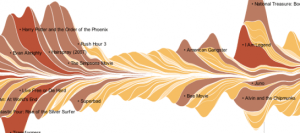
FlowingData has a 5 Best Data Vis of the year list, which I’m fond of. It includes the beautiful Streamgraphs of Byron and Wattenberg. Their technical report has some fun applications of combinatorial optimization to aesthetics.

Streamgraph at the box office

Lance Fortnow has a nice Complexity Year in Review on the Computational Complexity Blog. Unfortunately, I don’t have a beautiful illustration of Prasad’s result that Unique Games Conjecture implies semidefinite relaxations have optimal approximation ratios.

3 Comments

Filed under combinatorial optimization, general, TCS

Combinatorics of Malaria Eradication

Malaria infecting a mosquito

I’ve got at least 3 interesting blog posts worth of material on TCS applications for fighting malaria, but I haven’t had time to pen even one of them. Here is an abbreviated version:

Malaria is a major disease, something like the #3 infectious disease globally, and the #1 cause of both death and disability in many parts of Southern Africa.

The Gates Foundation is leading the charge to attempt to eradicate malaria from the world, and many national governments and NGOs are also involved in the fight.

There is a history of malaria eradication attempts, and the historic lesson is this: don’t start a fight with malaria unless you’re going to win.

Continue reading

1 Comment

Filed under combinatorial optimization, global health, TCS

Midwest Theory Day and Me

I’ll be talking about “Theoretical Computer Science in Global Health” as the invited speaker at the Midwest Theory Day this Saturday (Dec. 6). It sounds like it will be a fun workshop, a one day deal at Northwestern Univesity. If you’re in the area, I think you should come on by.

1 Comment

Filed under global health, TCS

Theory in Wikipedia

wikiScott Aaronson’s recent blog post about improving the state of computer science articles in Wikipedia has been generating some buzz this week. I’m happy to buzz along. Yay for Wikipedia!

Here are my top picks from Scott’s wishlist for the motivated encyclopedia writer:

  • Sketching algorithms
  • Streaming algorithms
  • Sparsest cut
  • Metric Embedding
  • Glauber dynamics
  • Average case complexity
  • Conductance (probability)
  • Max-flow min-cut

Frequent Wikipedia contributor David Eppstein also has his own todo list that you can draw inspiration from.

Comments Off on Theory in Wikipedia

Filed under TCS