
Perhaps more than I ever wanted to know about the state of the birth and death registration system in South Africa circa 2010: http://unstats.un.org/unsd/demographic/CRVS/Technical%20report%20SADC%20final%20v2.pdf
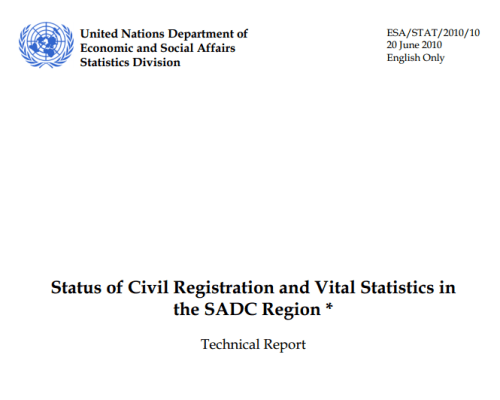
Perhaps more than I ever wanted to know about the state of the birth and death registration system in South Africa circa 2010: http://unstats.un.org/unsd/demographic/CRVS/Technical%20report%20SADC%20final%20v2.pdf
Comments Off on CVRS in 2010 Report
Filed under global health, Uncategorized
I’m always on the lookout for new tools that I should be using in my daily work. Here is a short write-up by #hackebola researcher Caitlin Rivers on the subject: http://www.caitlinrivers.com/blog/the-setup-tools-i-use-to-track-emerging-infectious-diseases
Comments Off on Tools They Use
Filed under global health
I’m going to give a Python Pandas guest lecture in the Python Science class next week, and I thought I’d take a look at the Pandas intros that are out there. There are a lot now! Here are some that I flipped through:
http://pandas.pydata.org/pandas-docs/stable/10min.html
http://nbviewer.ipython.org/gist/fonnesbeck/5850375
http://www.gregreda.com/2013/10/26/intro-to-pandas-data-structures/
http://www.gregreda.com/2013/10/26/working-with-pandas-dataframes/
http://www.gregreda.com/2013/10/26/using-pandas-on-the-movielens-dataset/
http://synesthesiam.com/posts/an-introduction-to-pandas.html
http://www.datarobot.com/blog/introduction-to-python-for-statistical-learning/
Click to access Python_introduction.pdf
Its fun being a teacher in the age of information.
Filed under education
A few links to Les Roberts blogging from Sierra Leone:
Les Roberts – “Day 10: Leaving Columbia to be at peace with Columbia”
Comments Off on Les Roberts blogs from Sierra Leone
Filed under global health
I gave a talk on automatic methods to map from verbal autopsy interview results to underlying causes of death last August, and I like the slides so much that I’m going put them online here. Cheers to the new IHME themed templates for Power Point!

Filed under machine learning
A follow-up on my recent adventure digging into the GBD 2010 risk factors, wherein I helped a fellow researcher find the specific diseases to which the risk factor DALYs are attributed (http://ihmeuw.org/2c6v ):

I helped find where to look at the risk factor attribution, but what if you want to download the numbers? The “download chart data as CSV” link gives you something, but it is not the risk factors, it is just the disease fractions of total DALYs:
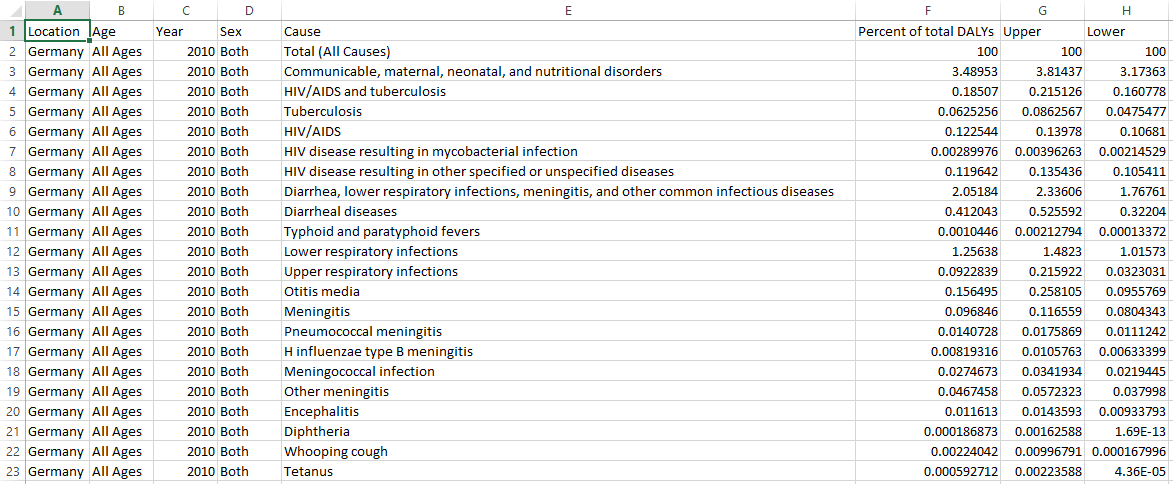
Fortunately, a javascript guru with a few minute told me the incantation to get the risk factor fractions out, recorded here for posterity:
$.fileDownload(app.settings.baseURL+'php/risk_data.php',{ httpMethod: "POST", data:{ measure: app.getMeasure(1, 'percent'), sex: app.getSex(1), age: app.getAge(1), year: app.getYear(1), location: app.getLocation(1), cause: d3.keys(app.metadata.causes), risk: app.getRisk(1), format: 'csv', title: app.charts[1].getTitle(), } });
Comments Off on Digging into the GBD 2010 Risk Factors II
Filed under global health
People are actually using mpld3. It would be great if there was more progress addressing the many issues that this use has uncovered. Interested?
Thanks for your interest in this project. I think that all of these points can be addressed, but it would be helpful to have a minimal example of python code that generates the issue in point (1) reliably. The github issue tracker has discussions related to points (3) and (4), and something that might be related to point (1). For point (2), it would be great to have a specific example in mind also, so that we can be sure any solution reduces file size substantially without compromising graphically accuracy.
- https://github.com/jakevdp/mpld3/issues/226 https://github.com/jakevdp/mpld3/issues/250
- Would be good to add an issue: https://github.com/jakevdp/mpld3/issues/new
- https://github.com/jakevdp/mpld3/issues/247
- https://github.com/jakevdp/mpld3/issues/198
As far as when all of these issues will be addressed, that is a pitfall of certain open-source projects that you might already be familiar with from your work with [related project]… I suspect that each fix will require a few hours of debugging at least, with (2) being easiest and (4) being hardest. I have a long list of issues to address, and although I’m happy to put these on it, I never seem to make progress on any of them.
Pull requests are certainly welcome, and if you or your collaborators wants to make these improvements, the mpld3 project will be happy to incorporate them into the codebase.
–Abie
Comments Off on Anyone want to fix things in mpld3?
Filed under software engineering
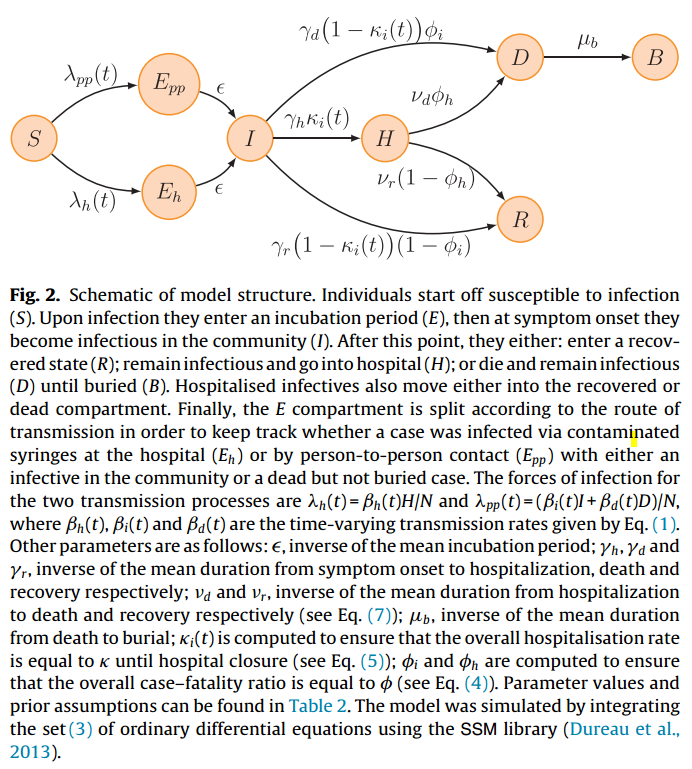
I’ve been watching as much as I can the Ebola outbreak in West Africa, and the role of epidemiological modeling in the response. The figure that most approaches start with is from here:

An important extension to the model appeared in a recent paper:
Comments Off on Math Epi Ebola Models
Filed under global health
I have to make the old DisMod-III website disappear (is it still here?). It is beautiful, but it is not available, and so I have to turn away researchers who want to use it for their own work. Fortunately, I can send them to a GitHub repository of DisMod code that they can use. But recently, it was not really DisMod that the emailing researcher wanted. I think they were really interested in digging into the details behind a figure like this one:

For that, there is a non-dead website I can offer: GBD Compare. Finding your way around it can be a bit of a challenge, though, so here is a link straight to the relative contribution of each nutritional risk factor for Germany and USA: http://ihmeuw.org/2c6t ; to see from which specific diseases the risk factor DALYs are attributed, you can use a different part of this tool, linked to here: http://ihmeuw.org/2c6v
Filed under global health
A colleague asked recently where to find different estimates of age- and sex-specific death counts for comparison purposes, and I told her that there should be some available on GapMinder. This was wrong (although you can compare child mortality rates there), so I did a little digging. Here are the results, in case they are useful for you, too:
If you want to explore the IHME data, here is a little notebook that you can use to get started.

Comments Off on Age- and sex-specific death data
Filed under global health
 Healthy Algorithms