
The IHME weekly seminar kicked off for the quarter last week with Ver Bilano’s work on Estimation of recent trends in tobacco use and baseline projections to 2025. Ver used DisMod-MR extensively for this project, so I knew I was going to love it ahead of time.
IHME Seminar: Tobacco 2025 Targets
Comments Off on IHME Seminar: Tobacco 2025 Targets
Filed under Uncategorized
Summer’s End
 There are new fellows running around, and classes are underway. I guess the summer is coming to an end. I wonder where it all went. No, I know where.
Comments Off on Summer’s End
Filed under Uncategorized
MCMC in Python: sim and fit with same model
Here is a github issue and solution that I saw the other day. I think it’s a nice pattern.
def generate_model(values={'mu': true_param, 'm': None}):

    #prior
    mu = pymc.Uniform("mu", lower=-10, upper=10, value=values['mu'],
        observed=(values['mu'] is not None))

    # likelihood function
    m = pymc.Normal("m", mu=mu, tau=tau, value=values['m'],
        observed=(values['m'] is not None))

    return locals()
Comments Off on MCMC in Python: sim and fit with same model
Filed under statistics
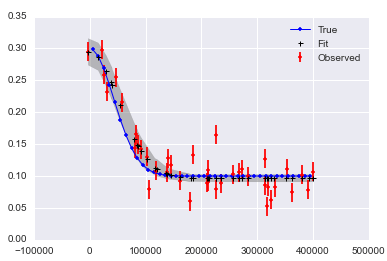
MCMC in Python: Fit a non-linear function with PyMC
Here is a recent q&a on stack overflow that I did and liked.
Comments Off on MCMC in Python: Fit a non-linear function with PyMC
Filed under statistics
Tabular Data in Python: Getting just the columns I want from pandas.DataFrame.describe
The Python Pandas DataFrame object has become the mainstay of my data manipulation work over the last two years. One thing that I like about it is the `.describe()` method, that computes lots of interesting things about columns of a table. I often want those results stratified, and `.groupby(col)` + `.describe()` is a powerful combination for doing that.
*But* today, and many days, I don’t want all of the things that `.describe()` describes. And the ones that I do want, I want as columns. Here is the recipe for that:
import pandas as pd

df = pd.DataFrame({'A': [0,0,0,0,1,1],
                   'B': [1,2,3,4,5,6],
                   'C': [8,9,10,11,12,13]})

df.groupby('A').describe().unstack()\
    .loc[:,(slice(None),['count','mean']),]
and out comes just what I wanted:
       B            C
   count  mean  count  mean
A
0      4   2.5      4   9.5
1      2   5.5      2  12.5
It took me a while to figure this out, and these docs helped:
http://pandas.pydata.org/pandas-docs/stable/reshaping.html#reshaping-by-stacking-and-unstacking
http://pandas.pydata.org/pandas-docs/stable/indexing.html#indexing-xs
Here it is as a ipython notebook.
(Note: this requires Pandas version at least 0.14.)
Comments Off on Tabular Data in Python: Getting just the columns I want from pandas.DataFrame.describe
Filed under software engineering
The one before that
Jake Vanderplas’s comparison of Python MCMC modules was preceded by a Bayesian polemic. In general, I find the stats philosophy war old-timey and distracting, but his comparison of confidence intervals and credible intervals is something I need to understand better.
http://jakevdp.github.io/blog/2014/06/12/frequentism-and-bayesianism-3-confidence-credibility/
Comments Off on The one before that
Filed under statistics
MCMC in Python: a bake-off
While I’m on a microblogging spree, I’ve been meaning to link to this informative comparison of pymc, emcee, and pystan: http://jakevdp.github.io/blog/2014/06/14/frequentism-and-bayesianism-4-bayesian-in-python/
Comments Off on MCMC in Python: a bake-off
Filed under statistics
MCMC in Python: Another thing that turns out to be hard
Here is an interesting StackOverflow question, about a model for data distributed as the sum of two uniforms with unknown support. I was surprised how hard it was for me.
I think the future of probabilistic programming should be to make a model for this easy to code.
Comments Off on MCMC in Python: Another thing that turns out to be hard
Filed under statistics
MCMC in Python: Never… no… always check for convergence
I’ve had no teaching responsibilities over the last quarter, and I must miss it. I’ve found myself responding to PyMC questions on StackOverflow more than ever before. It is an interesting window into what is hard in Bayesian computation. Checking (and achieving) MCMC convergence is one thing that is hard. Here are some questions and answers that include it:
http://stackoverflow.com/questions/24294203/difference-between-bugs-model-and-pymc/24347102#24347102
http://stackoverflow.com/questions/24242660/pymc3-multiple-observed-values/24271760#24271760
http://stackoverflow.com/questions/24402834/fitting-power-law-function-with-pymc/24413323#24413323
Comments Off on MCMC in Python: Never… no… always check for convergence
Filed under statistics
Graduation Congratulations 2014
This is the season of graduation activities at IHME and UW. Congrats to my colleagues completing their fellowships!
Comments Off on Graduation Congratulations 2014
Filed under Uncategorized
 Healthy Algorithms