Last week I gave a talk on my work on the Iraq mortality survey. It was the first time that I’ve had a chance to talk about it since our paper was published. And since the data is all online and the scientific python tools are getting slick, I was able to make charts like this one:
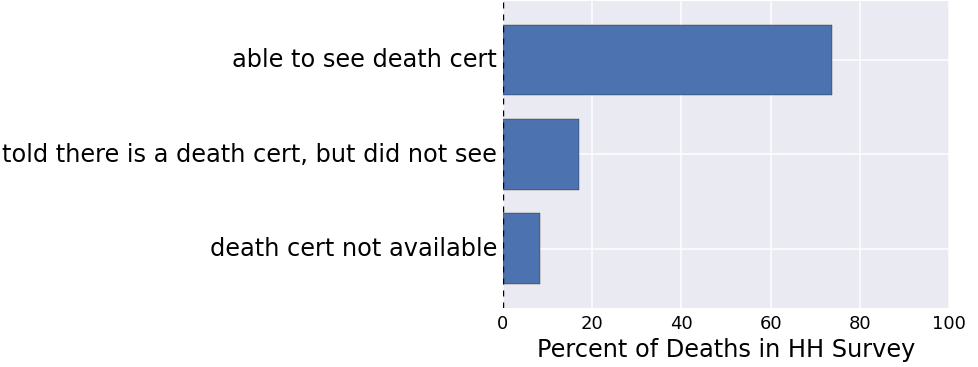
Open data and the scientific python ecosystem is making my life easier
Comments Off on Open data and the scientific python ecosystem is making my life easier
Filed under global health
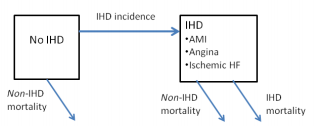
GBD 2010: The Global Burden of Ischemic Heart Disease in 1990 and 2010: The Global Burden of Disease 2010 Study
I wish I had been more diligent in collecting the disease-specific papers that have come out following the Global Burden of Disease 2010 Study… here is the latest one to go into print: Moran et al, The Global Burden of Ischemic Heart Disease in 1990 and 2010: The Global Burden of Disease 2010 Study, in Circulation.
Comments Off on GBD 2010: The Global Burden of Ischemic Heart Disease in 1990 and 2010: The Global Burden of Disease 2010 Study
Filed under global health
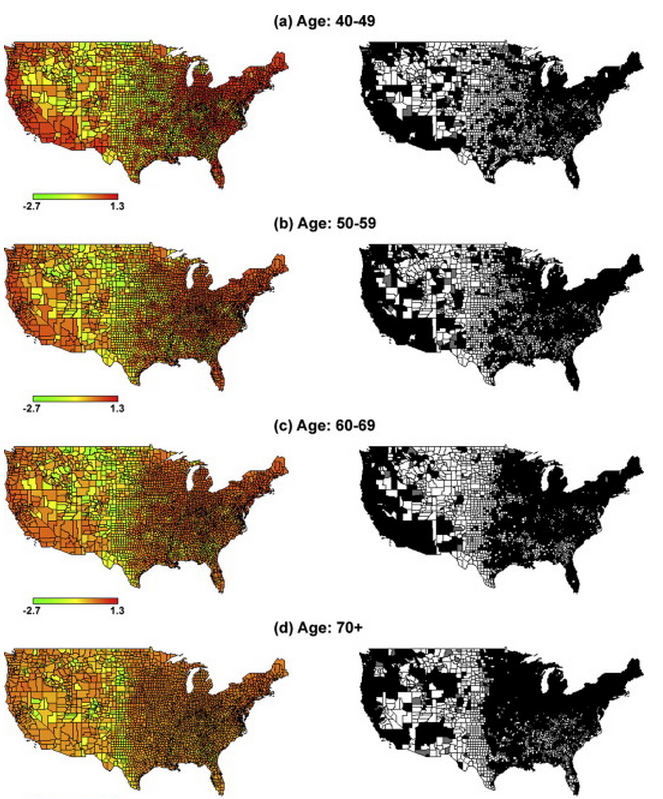
Journal Club: Efficient mapping and geographic disparities in breast cancer mortality at the county-level by race and age in the U.S.
Last week, we read Chien et al, Efficient mapping and geographic disparities in breast cancer mortality at the county-level by race and age in the U.S. I’ve been very interested in these sort of “small-areas” spatial statistical methods recently, so it was good to see what is out there as the state of the art. I think I’ve got something to contribute along these lines some day soon.
Filed under statistics
Journal Club: Transmission Assessment Surveys (TAS) to Define Endpoints for Lymphatic Filariasis Mass Drug Administration: A Multicenter Evaluation
While I’m catching up on journal club reading, two weeks ago we discussed Chu et al, Transmission Assessment Surveys (TAS) to Define Endpoints for Lymphatic Filariasis Mass Drug Administration: A Multicenter Evaluation, which takes on the question of how to decide when it is safe to stop a massive disease elimination program. This work must rely on some cool mathematical epi modeling, to say how many years of what level of coverage is necessary before you can hope the LF is gone.
Comments Off on Journal Club: Transmission Assessment Surveys (TAS) to Define Endpoints for Lymphatic Filariasis Mass Drug Administration: A Multicenter Evaluation
Filed under disease modeling, global health
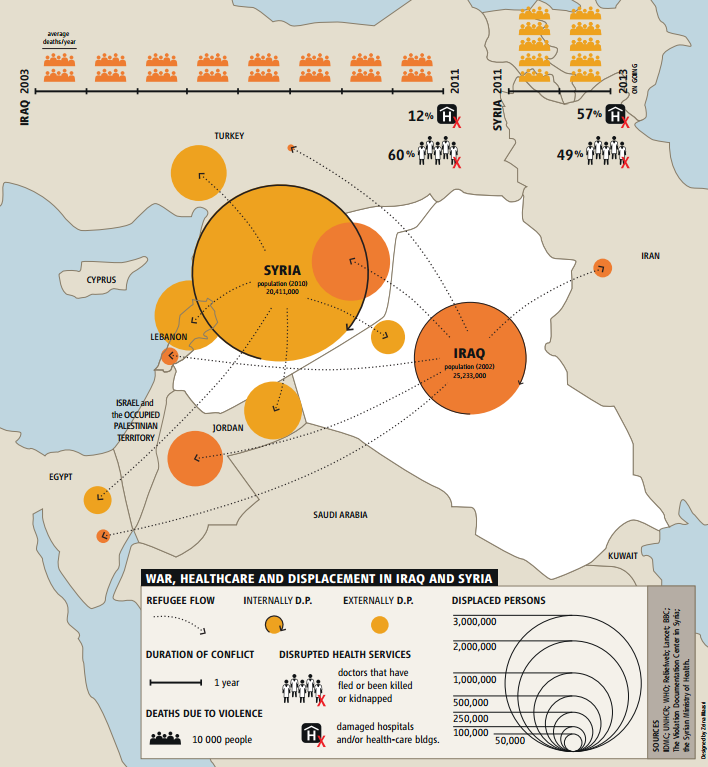
Journal Club: Changing therapeutic geographies
We had a very different sort of research paper in journal club three weeks ago, and I was too busy to jot it down until now. Dewachi et al, Changing therapeutic geographies of the Iraqi and Syrian wars. This is certainly not our usual metrics-heavy approach, so it was good exercise to try to understand it.
Comments Off on Journal Club: Changing therapeutic geographies
Filed under global health
IHME Seminar: Universal health coverage, equity, and health outcomes
Last week we had a talk from Rodrigo Moreno-Serra on Universal health coverage, equity, and health outcomes. This research used instrumental variables to show that universal health coverage is good for health. One day I will understand instrumental variables—I think there should be a simple way to explain it to combinatorialists who know some epidemiology.
Comments Off on IHME Seminar: Universal health coverage, equity, and health outcomes
Filed under Uncategorized
MCMC in Python: random effects logistic regression in PyMC3
It has been a while since I visited my pymc-examples repository, but I got a request there a few weeks ago about the feasibility of upgrading the Seeds Example of a random effects logistic regression model for PyMC3. It turns out that this was not very time consuming, which must mean I’m starting to understand the changes between PyMC2 and PyMC3.
See them side-by-side here (PyMC2) and here (PyMC3).
Comments Off on MCMC in Python: random effects logistic regression in PyMC3
Filed under statistics
IHME Seminar: Crowds, crisis, and convergence: crowdsourcing in the context of disasters
Last week for IHME seminar, we heard from Kate Starbird about Crowds, crisis, and convergence: crowdsourcing in the context of disasters. It reminded me of the visual displays of quantitative information I hacked on after the 2010 earthquake in Haiti.
Did I ever tell you how the US State Department called to ask if they could use that graphic in a presentation? I thought it was a prank.
As often is the case, a recording of the talk is available online.
Comments Off on IHME Seminar: Crowds, crisis, and convergence: crowdsourcing in the context of disasters
Filed under global health, videos
BigCLAM talk
My grad school colleague Jure Leskovec was at UW recently, talking about a cool new model for clusters in random graphs. It was part generative model, and part statistical model, and made me miss my grad school days when I spent long hours proving theorems about such things. This statistical part of his model has a very forced acronym: BigCLAM, and also a software implementation: https://github.com/snap-stanford/snap/tree/master/examples/bigclam
Maybe one day I’ll get to do some applied network research for global health, and have a chance to use this.
Comments Off on BigCLAM talk
Filed under Uncategorized
IHME Seminar: Unifying the Counterfactual and Graphical Approaches to Causality via Single World Intervention Graphs (SWIGs)
Thomas Richardson gave a recent seminar at IHME about how the potential outcomes crowd can make sense of graphical models and vice versa. It also has a CSSS working paper to complement it, a trend in our recent seminars: http://www.csss.washington.edu/Papers/wp128.pdf
This talk had some great graphics, as I would hope for in a talk on graphical modeling:

Comments Off on IHME Seminar: Unifying the Counterfactual and Graphical Approaches to Causality via Single World Intervention Graphs (SWIGs)
Filed under statistics