
I almost didn’t share these HarleMCMC videos, but how long could I resist, really?
We’ll see how this holds up to repeated viewing…
Here is a math/dance video for the ages:
I almost didn’t share these HarleMCMC videos, but how long could I resist, really?
We’ll see how this holds up to repeated viewing…
Here is a math/dance video for the ages:
Comments Off on Math and Dance
Filed under MCMC, Uncategorized
Continuing my experiment using Stan in IPython, here is a notebook to do a bit of the eight schools example from the RStan Getting Started Guide.
Comments Off on Stan in IPython: reproducing 8 schools
Filed under software engineering
There has been a low murmur about new MCMC package bouncing through my email inbox for a while now. Stan, it is. The project has reached the point where the developers are soliciting Python integration volunteers, so I decided it is time to check it out.
Good news, it installed and ran the example without frustration! I don’t take that for granted with research software.
Comments Off on Stan in IPython: getting starting
Filed under software engineering
This week brings another locally grown reading to our journal club, Algorithms for enhancing public health utility of national causes-of-death data. As they say in the text:
While some practitioners may object to the term “garbage code” as pejorative, alternative terms have not yet caught on in the literature. We follow this practice and use the term garbage code (GC) to refer to all deaths assigned to codes that should be redistributed to enhance the validity of public health analysis.
Comments Off on Journal Club: Garbage code redistribution
Filed under global health
Very cool new visualizations of the GBD2010 results are now on-line: http://viz.healthmetricsandevaluation.org/gbd-compare/

Comments Off on GBD Country-level Visualizations
Filed under global health
This week’s journal club selection is Performance of Health Workers in the Management of Seriously Sick Children at a Kenyan Tertiary Hospital: Before and after a Training Intervention by Irimu et al. That sounds hard to quantify, so I wonder how they did it.
Comments Off on Journal club: Performance of Health Workers in the Management of Seriously Sick Children at a Kenyan Tertiary Hospital
Filed under global health
I’m spending yesterday and today helping out with a two day software carpentry workshop at UW.
Software Carpentry helps researchers be more productive by teaching them basic computing skills. We run boot camps at dozens of sites around the world, and also provide open access material online for self-paced instruction. The benefits are more reliable results and higher productivity: a day a week is common, and a ten-fold improvement isn’t rare.
I am impressed by the curriculum and by the attention to evaluation, not an easy task in any educational setting. The 20% productivity increase is an interesting claim. From what I observed yesterday, I would expect huge heterogeneity based on past experience, and I would expect this heterogeneity to be hard to predict.
I’m sure reading a lot lately. That is good. This week, I’m filling in for the PBF journal club, too, and today we’ll be discussing Ciesielski et al’s paper Cadmium Exposure and Neurodevelopmental Outcomes in U.S. Children, which uses 6 years of NHANES data to weigh the evidence that low levels of cadmium cause learning disabilities in children.
All the data is available on the CDC’s website, so I thought I’d take a look at it. Here is an interesting little plot that popped out: prevalence of parent-reported learning disabilities in 6-15 year olds as a function of income-to-poverty-line ratio.
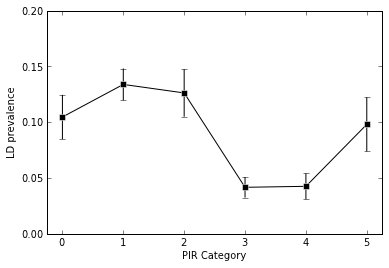
Would you have expected that?
Filed under global health, Mysteries
I wonder how we’ll tear holes in the arguments of this week’s journal club papers, since they are locally produced:
Also have a look at the accompanying visualizations.
Comments Off on Journal Club: GBD 2010
Filed under global health
There are a couple of Kaggle contests that I call your attention to, now that I have been convinced contests are fun, not tacky: Whale Detection Challenge and
Predicting Parkinson’s Disease Progression. The are both the kind of thing that someone might call “Big Data”, but in two different dimensions.
The whales have 23 teams entered at the time of writing, while PD has zero. I bet that is because there is a way to score interim results on whale detection, but the PD contest is judged based on a 5 page report.
Filed under machine learning
 Healthy Algorithms