Health Care Reform, Accountability, Disparity

I got some good news for the weekend, an opinion piece that I wrote together with some of the other post-graduate fellows at IHME was published online as a Science e-letter. It is titled U.S. Health Care Reform: The Case for Accountability and it’s about the measuring the outputs, outcomes, and impacts of the reform, whatever shape they end up taking.

The part that I was especially interested in adding to the discussion appears in paragraphs 3 and 4, about what these some of these statistics look like currently:

Disparities in health outcomes in the U.S. are unacceptable. A healthy life expectancy at birth in the U.S. ranks behind 28 other developed countries (1). Sizable groups in the United States have mortality risks resembling those in sub-Saharan Africa (2), including urban blacks between the ages of 15 and 64 living in counties with high homicide rates.

On average, Asian women lived 21 years longer than high-risk urban black males in 2001 (2). Although life expectancy for most American women increased between 1983 and 1999, life expectancy for women in 180 counties in areas such as Appalachia, the Deep South, the southern Midwest, and Texas decreased by 1.3 years (3).

I made some figures to accompany this, which Science didn’t print, so I’ve included them for you here:
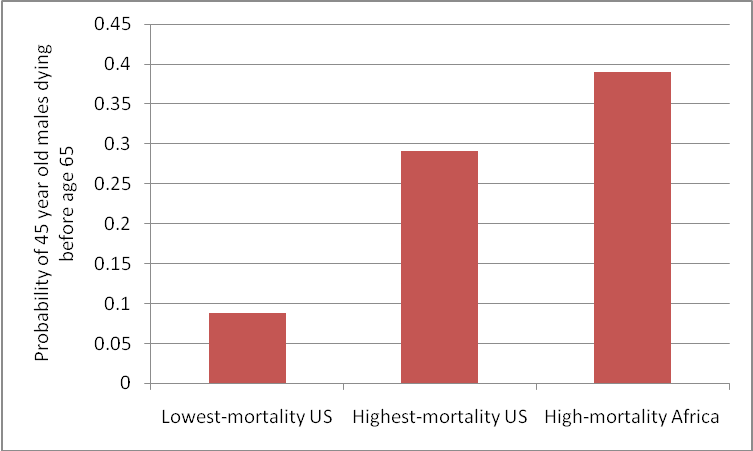
Probability of a 45 year-old male dying before age 65, 2001, from Murray et al., Eight Americas: Investigating mortality disparities across races, counties, and race-counties in the United States. PLoS Medicine 2006.

Female life expectancy in US counties, 1961-1999 from Ezzati et al., The reversal of fortunes: Trends in county mortality and cross-county mortality disparities in the United States. PLoS Medicine 2008.

9 Comments

Filed under global health, science policy

ACO in Python: Shortest Paths in NetworkX

I’m supposed to be doing the final edits on the journal version of this old paper of mine (jointly with Greg Sorkin and David Gamarnik), but I’ve thought of a way to procrastinate.

Instead of checking the proofs that the length of the shortest path in my weigthed width-2 strip is \frac{p^2(1+p)^2}{(3p^2+1)} n, I’ll make a quick blog post about verifying this claim numerically (in python with networkx). This also gives me a chance to try out the new networkx, which is currently version 1.0rc1. I think it has changed a bit since we last met.

from pylab import *
from networkx import *

G = Graph()
for u, v in grid_2d_graph(100, 2).edges():
    G.add_edge(u, v, weight=rand() < .5)

wt, p = bidirectional_dijkstra(G, (0,0), (99,1))

Continue reading

2 Comments

Filed under combinatorial optimization

Multilevel (hierarchical) modeling: what it can and cannot do in Python


I re-read a short paper of Andrew Gelman’s yesterday about multilevel modeling, and thought “That would make a nice example for PyMC”.  The paper is “Multilevel (hierarchical) modeling: what it can and cannot do, and R code for it is on his website.

To make things even easier for a casual blogger like myself, the example from the paper is extended in the “ARM book”, and Whit Armstrong has already implemented several variants from this book in PyMC. Continue reading

17 Comments

Filed under MCMC, statistics

Machine Translation and the Porpoise Corpus

I might have mentioned that I got to do some world traveling for my work recently. Seeing rural Tanzania was an experience that I still don’t really have good words to describe. But this is not a post about that. This is a post about a sticky idea I got stuck on in some science fiction I was reading during my multi-day to and fro travel.

On my around-the-world-in-4.5-days journey, I read the Jewish feminist sci-fi novel He, She, and It by Marge Piercy. It’s got a classic hard AI theme, about a robot that is so, so human… I’d recommend it. But dilemmas of whether a robot can make a minyon in the reform tradition of 2059 has not stuck in my mind the way this one line about whales has: Continue reading

6 Comments

Filed under Mysteries

Paper rejected, Cheer Up with Baby Animals

Too bad for me, my first global health paper will have to be revised and resubmitted. In addition to some more substantive objections, the negative reviewer said “It is unclear what software was used to carry out the Bayesian estimation by MCMC. This is not possible in STATA and would be extremely difficult in the scripting language, Python.” It was difficult in Python! I doubt that any software would make it much easier, though.

To cheer myself up, I’ve been looking into the newest fads in pets: robotic hamsters and teacup pigs.

5 Comments

Filed under global health

Post-doc Ops

Would you like to work with me applying computational algorithms to challenges in global health metrics? Then apply for the IHME post-graduate fellowship. Deadline is Feb 15.

(There is also a “pre-graduate” version, for those who have not started graduate school yet.)

Comments Off on Post-doc Ops

Filed under education, global health

Clustering with Shallow Trees

I’m updating my CV, and that reminded me that I meant to promote this cool clustering technique that I was a little bit involved in, Clustering With Shallow Trees.
This goes way back to about half-way through my post-doc at MSR, when statistical physicist Riccardo Zecchina was visiting for a semester, and was teaching me about all of the “intractable” optimization problems that he can solve using his panoply of propagation algorithms. In particular, he was working on algorithms for certain types of steiner tree optimization, and he had discovered that adding an extra constraint on the depth of the tree didn’t make the problem harder. (All variants of the problem he considers are NP-hard, but some are NP-harder than others.) Continue reading

4 Comments

Filed under combinatorial optimization

Dense-Subset Break-the-Bank Challenge

I’m preparing for my first global travel for global health, but the net is paying attention to a paper that I think I’ll like, and I want to mention it briefly before I fly.

Computational Complexity and Information Asymmetry in Financial Products is 27 pages of serious TCS, but it is so obviously applicable that people outside of our particular ivory tower, and even outside of academia entirely are blogging and twittering about it, and even reading it!

Freedom to Tinker has a nice summary of this paper, if you want to know what it’s about in a hurry.

Mike Trick makes the salient observation that NP-hard doesn’t mean computers can’t do it. But the assumption that this paper is based on is not about worst-case complexity; it is, as it should be, based on an assumption about the average-case complexity of a particular optimization problem over a particular distribution.

As it turns out, this is an average-case combinatorial optimization problem that I know and love, the densest subgraph problem. My plan is to repeat the problem here, and share some Python code for generating instances of it. Then, you, me, and everyone, can have a handy instance to try optimizing. I think that this problem is pretty hard, on average, but there is a lot more chance of making progress on an algorithm for it than for cracking the P versus NP nut. Continue reading

4 Comments

Filed under combinatorial optimization, cryptography, TCS

The Two Rules of Program Optimization

Wow, where does the day go? I spent all my non-meeting time debugging something. At least I fixed it before 5 PM.

The details of the problem are boring, but the whole ordeal could have been avoided if I had just followed the two rules of optimizing software in my Generic Disease Modeling System. What are they?

      First Rule of Program Optimization: Don’t do it
      Second Rule of Program Optimization (for experts only!): Don’t do it yet

Maybe next week I’ll get a second to write about the good kind of optimization; my statistical physics friends have posted an article on the arxiv which I am a co-author on, about an application of bounded-depth minimum spanning trees, Clustering with Shallow Trees.

Comments Off on The Two Rules of Program Optimization

Filed under software engineering

Conference you should know about

This weekend marks the submission of my first “Global Health” paper. Congratulations to me! And many, many thanks to all the people who have worked with me to make it happen. I’ll go into details sometime in the future, first let me see how things go in the refereeing process.

While I was over-working on that business, I got an interesting Call-for-Papers forwarded from global health/AI researcher Emma Brunskill. The AAAI Spring Symposium on Artificial Intelligence for Development (AI-D) is an effort to build a community of people applying computer science and artificial intelligence in less-developed settings.

TCS people, don’t let the “AI” in their title turn you off. Eric Horvitz says that this is for all of us. Continue reading

Comments Off on Conference you should know about

Filed under global health, TCS